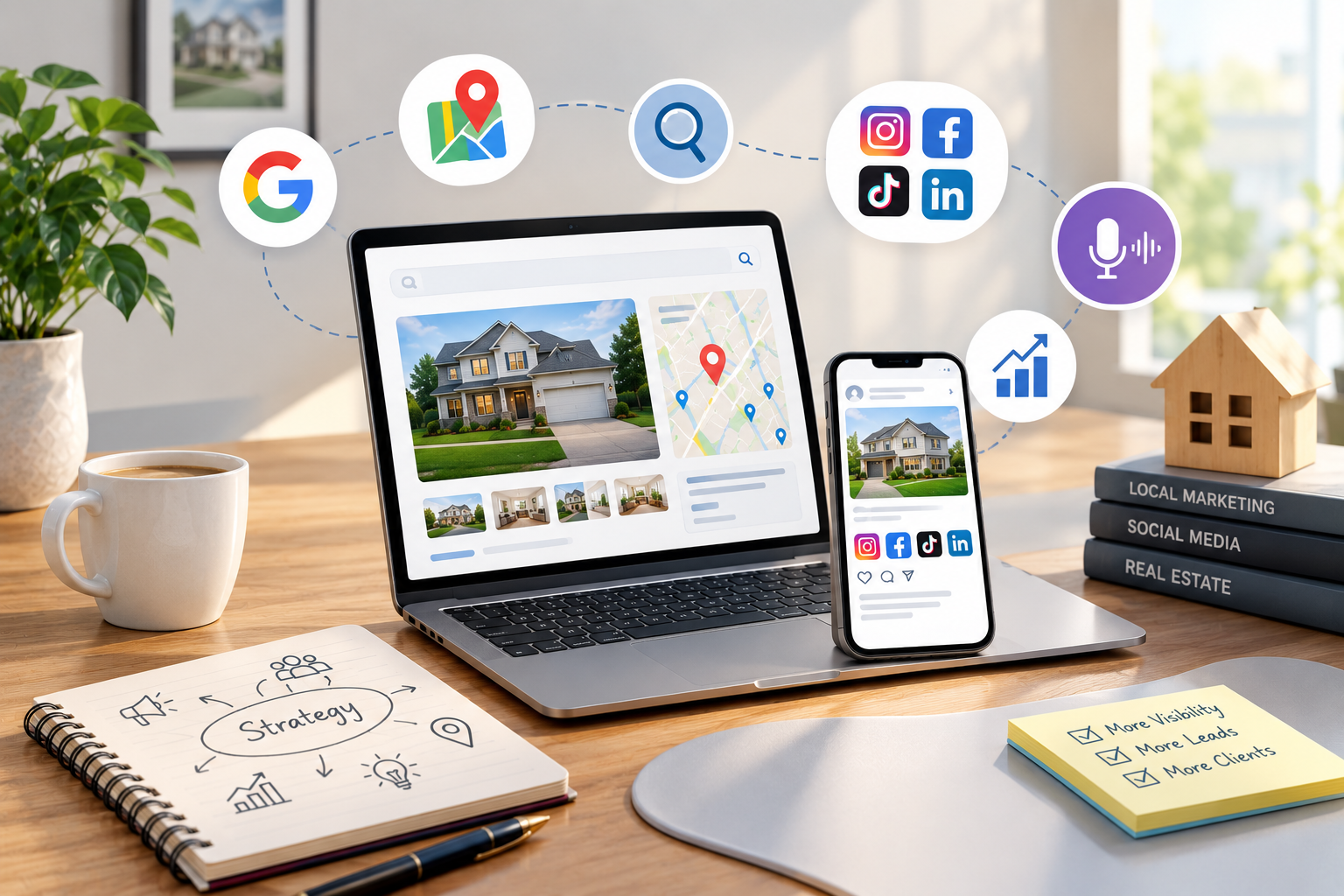
Real estate marketing is changing quickly. Buyers and sellers are no longer relying on one search engine, one property portal, or one type of content to make decisions. They may discover an agent through Google, an AI-powered search tool, social media, voice search, local recommendations, or an interactive property experience.
For real estate professionals, this shift makes a strong digital presence more important than ever. Digital marketing for realtors in 2026 is not simply about posting listings or running advertisements. It is about creating useful content, improving local visibility, understanding prospective clients, and staying present throughout the entire buying and selling journey.
The most effective strategies combine technology with a clear understanding of the local market. Here are the trends and tactics shaping digital marketing for realtors in 2026.
What's Changing in Real Estate Marketing in 2026
Real estate marketing is becoming more personalized, localized, and technology-driven. Traditional listing promotion still matters, but it is increasingly being supported by AI, first-party data, interactive experiences, and hyperlocal content.
One major change is how people discover information. Search behavior is expanding beyond traditional keyword searches. Buyers may ask conversational questions, use voice assistants, explore map results, or ask AI tools for recommendations. This means realtors need content that clearly answers the questions potential clients are asking.
The focus is shifting from individual listings to long-term visibility, as agents can use useful local content, consistent communication, and recognizable expertise to stay visible between transactions. Digital marketing for realtors supports this long-term strategy by helping attract attention, build trust, and generate opportunities even when fewer properties are active.
AI-Powered Content and Lead Nurturing
AI is becoming an important part of content creation and lead management. Realtors can use AI tools to identify common customer questions, develop content ideas, personalize communication, and organize follow-up processes.
AI can help realtors organize content around buyer and seller questions, such as neighborhood purchasing considerations, property preparation, and local factors affecting home values, while keeping the final content grounded in the agent’s local knowledge and experience. It can also support lead nurturing by creating different communication paths for first-time buyers, sellers, investors, and past clients, making it easier to maintain consistent communication at scale without replacing personal relationships. In digital marketing for realtors, combining AI efficiency with human expertise can create a more consistent experience from the first interaction through follow-up.
Voice Search and Local Discovery Optimization
People increasingly use conversational searches when looking for local services and information. Instead of typing a short phrase, a potential client might ask, “Who are the best real estate agents near me?” or “What should I know about buying a home in this neighborhood?”
This creates an opportunity for realtors to optimize their online presence around natural questions and local intent.
Local discovery should include accurate business information, location-specific website content, useful neighborhood pages, and answers to common real estate questions. Content should clearly communicate the markets and communities an agent serves.
Realtors should also consider how their information appears across search platforms, maps, directories, and AI-driven discovery experiences. Consistency matters because inaccurate or incomplete business information can make it harder for potential clients to understand where an agent operates.
The objective is to make the agent easier to discover when someone is actively looking for local real estate help.
Interactive Property Experiences and Virtual Tours
Property marketing is becoming more interactive. High-quality photography remains important, but buyers increasingly expect digital experiences that provide more information before they schedule an in-person visit.
Virtual tours, interactive floor plans, video walkthroughs, and other digital property experiences help buyers understand a property remotely, especially when relocating or comparing multiple properties. These experiences can show the layout, key features, and overall condition more effectively than static images, while neighborhood walkthroughs, local business features, market updates, and educational videos can demonstrate a realtor’s local expertise and provide useful content across websites, social platforms, search results, and other digital channels.
First-Party Data Strategies for Realtors
As digital marketing becomes more privacy-conscious, first-party data is becoming increasingly valuable. First-party data is information that a business collects directly through its own interactions with customers and prospects.
For realtors, first-party data can include website inquiries, newsletter subscriptions, consultation requests, property preferences, and previous client information collected through website forms, property alerts, downloadable resources, and email subscriptions. Realtors can organize this information by interests, buying timelines, locations, or previous interactions to provide more relevant communication and build direct relationships while reducing reliance on third-party platforms.
Hyperlocal Marketing Campaigns
Local expertise is one of the strongest advantages a realtor can communicate online. In 2026, hyperlocal marketing gives agents an opportunity to move beyond general real estate content and focus on specific communities.
A hyperlocal campaign can focus on individual neighborhoods, suburbs, communities, school areas, local amenities, market conditions, or lifestyle-related topics.
For example, instead of creating a general article about buying a home, a realtor could develop useful information about the buying process in a specific local market. This can help demonstrate familiarity with the area while also targeting people searching for location-specific information.
Hyperlocal marketing can extend across website pages, blog content, videos, social media, email campaigns, and local advertising.
The key is consistency. An agent who regularly publishes useful information about a specific market can build a stronger digital footprint than one who only publishes promotional listing content.
Emerging Advertising Opportunities
Paid advertising continues to be an important part of real estate marketing, but the opportunities available to advertisers are expanding.
Search, social, and video advertising can help realtors reach active prospects, build awareness, retarget audiences, and showcase agents or properties. Paid campaigns should work alongside organic marketing by promoting useful local guides, market reports, property videos, or consultation offers that direct visitors to a website for further engagement. Realtors should also test new platforms, audiences, creative formats, messages, and landing pages to identify what delivers meaningful results. Effective digital marketing for realtors combines paid campaigns with valuable content and strong follow-up rather than focusing only on impressions.
Preparing for the Next Wave of Digital Marketing
The next phase of real estate marketing will continue to combine search, AI, local discovery, data, content, advertising, and interactive experiences. Realtors do not need to adopt every new technology immediately, but they do need a digital foundation that can adapt as buyer behavior changes.
That foundation should include a clear website, useful local content, accurate business information, consistent communication, strong lead follow-up, and a strategy for building direct relationships with potential clients.
Realtors should regularly review how prospects discover their business through search, AI tools, social platforms, maps, and voice queries, and adapt their marketing accordingly. The strongest approach to digital marketing for realtors is a connected strategy that keeps agents discoverable, useful, and credible across multiple digital touchpoints, helping them maintain visibility, build stronger relationships, and create opportunities beyond individual property listings.