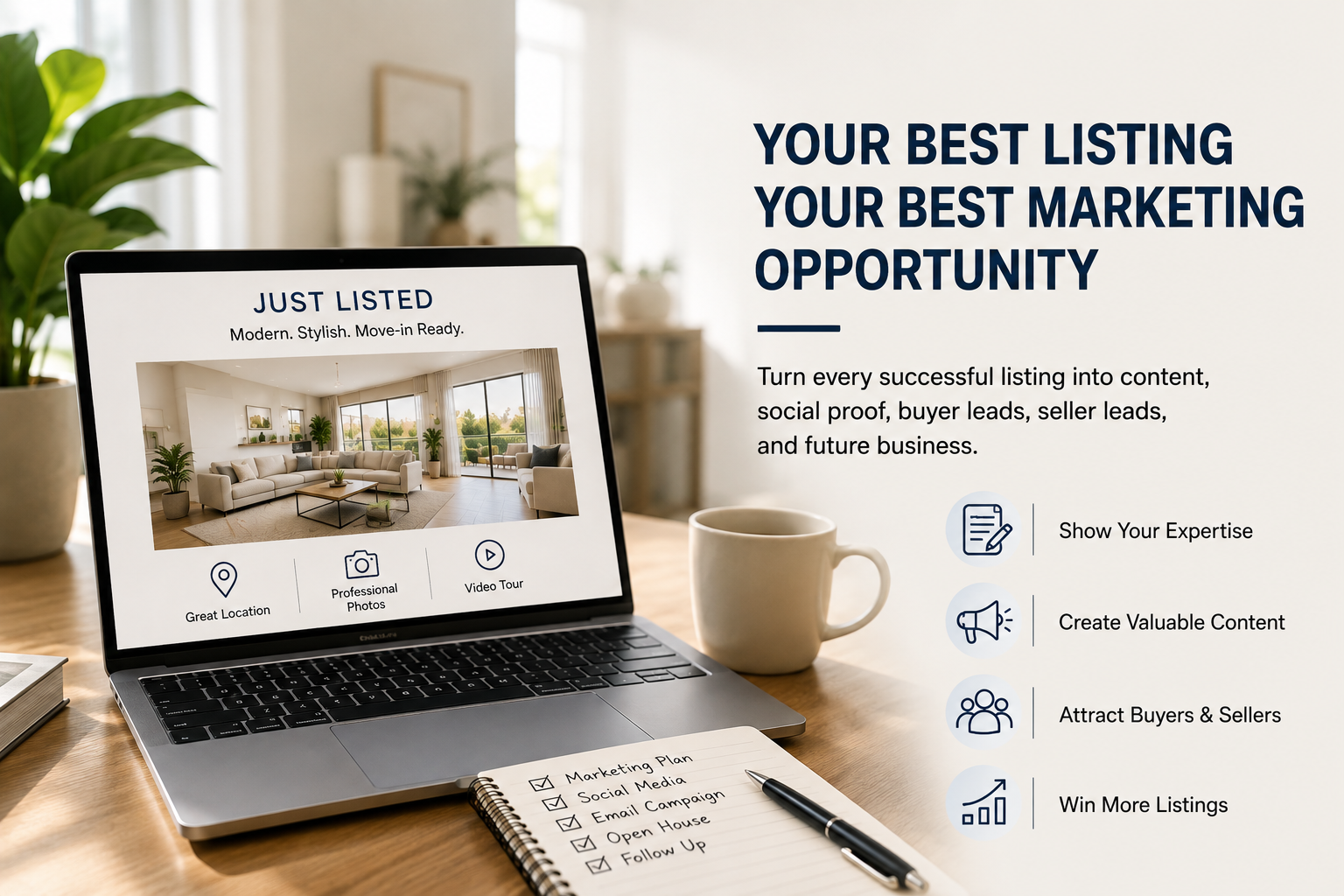
A successful real estate listing should do more than attract buyers. It should also demonstrate your marketing process, show your local expertise, generate useful content, and create proof that future sellers can trust.
This is why digital marketing for realtors should not stop when a property goes live. Every listing can become a long-term marketing asset that supports your website, social media, email campaigns, local SEO, and future listing presentations.
A Listing Is More Than a property to Sell
A listing is a real-world example of how you work. It gives potential clients an opportunity to see how you present a property, communicate its value, reach the right audience, and manage the selling process.
Instead of treating a listing as a single MLS entry, think of it as the center of a marketing campaign. The campaign may include:
- A dedicated property page on your website.
- Professional photographs and video.
- Social media posts and short-form videos.
- An email announcement to buyers and past clients.
- A neighborhood-focused blog post.
- An open house promotion.
- A market update based on buyer interest.
- A case study after the property sells.
A strong listing campaign uses multiple digital channels, including websites, social media, email, search engine optimization, and targeted advertising. This gives the property more visibility while showing potential sellers that your marketing approach is organized and measurable.
The goal is not to promote the property everywhere without a plan. The goal is to communicate one clear story across the channels where your ideal clients are most likely to find you.
Turn Your Listing into a Marketing Asset
A marketing asset is any piece of content or proof that continues to support your business after it is created. A well-marketed listing can produce several of these assets.
Create a dedicated property page
Build a page on your website for each major listing. Include the property details, location, photographs, video, floor plan, showing information, and a clear contact option.
The page should also explain what makes the property valuable. Rather than repeating only the number of bedrooms and bathrooms, describe the lifestyle, convenience, location, layout, and features that matter to the intended buyer.
Add descriptive page elements such as:
- A specific title that includes the neighborhood or city.
- A concise meta description.
- Optimized image file names and alt text.
- Internal links to buyer guides, neighborhood pages, and market reports.
- A clear call to action, such as “Schedule a private showing.”
Rich media can make a listing more useful and engaging. Professional photography, video walkthroughs, 3D tours, and floor plans can help buyers understand the property before they schedule a visit.
Build a consistent campaign
Use the same core message in your listing page, email, social posts, and advertisements. Consistency helps people recognize the property and understand its main selling points.
For example, if the central message is “a move-in-ready home near downtown,” use that positioning in:
- The property page headline.
- The Instagram caption.
- The email subject line.
- The open house announcement.
- The video description.
- The paid advertising copy.
This approach creates a connected campaign instead of a collection of unrelated posts.
Showcase Your Expertise Through the Listing
Buyers may be interested in the property, but sellers are also watching how you market it. A listing gives you a practical way to demonstrate your skills before a future client contacts you.
Explain the decisions behind the campaign. You could share:
- Why the property was positioned for a specific buyer group.
- How the asking price was supported by market data.
- Why professional photography was selected.
- Which improvements helped the home show better.
- How the listing was promoted locally.
- What buyer questions appeared most often.
- How showing activity influenced the next marketing step.
This type of content separates you from agents who only post “Just Listed” or “Sold” graphics. It shows that you understand strategy, audience targeting, presentation, and follow-up.
For example, a short video could explain:
“This home had strong features, but the original photos did not show the natural light in the main living area. We changed the photography schedule, updated the property presentation, and used a video walkthrough to give buyers a clearer view of the space.”
That message promotes the listing while also demonstrating your problem-solving ability.
Social media can support this process when it is used to build local connections and communicate your value, not only to promote properties.
Get More Content from Every Listing
One listing can support weeks of useful content if you plan the campaign before publishing the first post.
Content ideas for one listing
- A “Coming Soon” teaser.
- A short video showing the best feature.
- A carousel explaining the floor plan.
- A neighborhood guide.
- A post about the property’s commute, schools, parks, or amenities.
- A buyer FAQ based on questions received during showings.
- A behind-the-scenes post about preparing the property.
- An open house reminder.
- An offer or negotiation update, where appropriate.
- A “What buyers loved about this home” post.
- A final sold case study.
You can also adapt the content for different platforms. A long-form property story may work well on your website, while a 30-second walkthrough may be better for Instagram, YouTube Shorts, or TikTok.
A content calendar can help you plan posts around important stages such as a new listing, open house, contract acceptance, and closing. Local SEO should also be part of the process. Include relevant city, neighborhood, and ZIP code terms when they accurately describe the property and the audience.
Do not create content simply to fill a schedule. Each piece should answer a question, explain a decision, highlight a local feature, or help a potential client understand your process.
Keep the Marketing Working After the Sale
The listing should not disappear from your marketing system as soon as it closes. After the sale, update the property page and turn the campaign into a case study.
A useful case study can include:
- The original marketing challenge.
- The property’s strongest selling points.
- The campaign channels used.
- The type of content created.
- Buyer engagement or inquiry trends.
- The result of the campaign.
- A client testimonial, with permission.
Avoid sharing confidential information or making unsupported claims. If you mention the sale price, time on market, number of offers, or another performance detail, verify that the information is accurate and permitted by local rules and your brokerage policies.
You can also create an evergreen article such as:
- “How We Marketed a Home in [Neighborhood].”
- “What Helped This [Property Type] Stand Out.”
- “A Real Estate Marketing Case Study from [City].”
These pages can support local search and help future sellers evaluate your services. They also provide a more meaningful example of your work than a simple “sold” announcement.
Turn Successful Listings into Future Opportunities
The strongest listing marketing connects the property to the next business opportunity. Add a relevant call to action to every major asset.
Examples include:
- “Thinking about selling in [Neighborhood]? Request a home marketing consultation.”
- “Want to know how your home would be positioned online? Contact our team.”
- “Download our seller marketing checklist.”
- “Get a local pricing and marketing review.”
- “See how we prepare homes for launch.”
You can also use the listing to support follow-up campaigns. Someone who downloads a property guide may not be ready to buy immediately, but they may become a future client. Add qualified contacts to your CRM, segment them by interest, and send useful updates rather than generic promotional messages.
After the transaction, continue communicating with the seller and buyer. Ask for a review when appropriate, request permission to use approved photos or testimonials, and stay connected through relevant market updates.
A successful listing can generate:
- Seller leads.
- Buyer leads.
- Referral opportunities.
- Website traffic.
- Social proof.
- Local search content.
- Email subscribers.
- Material for future listing presentations.
The key is to build a repeatable process. For every listing, decide in advance what content will be created, where it will be published, how leads will be captured, and which performance indicators will be measured.
Conclusion
Your best listing is not only a property to sell. It is evidence of your marketing ability and a source of content that can continue working for your business. Realtor Marketing Labs helps real estate professionals turn successful listings into valuable marketing opportunities.
With a focused digital marketing for realtors strategy, one listing can become a website page, social media campaign, video series, email sequence, local SEO asset, and client case study. The more consistently you document and reuse the work, the more value each listing can create.
A property may sell once, but the marketing systems and proof built around it can help you win future clients for much longer.
FAQs
1. How can a real estate listing become a marketing asset?
A listing can generate website content, social media posts, videos, email campaigns, local SEO content, testimonials, and case studies. These assets can continue supporting visibility and lead generation after the property is sold.
2. What content can real estate agents create from one listing?
Agents can create coming-soon posts, property videos, neighborhood guides, buyer FAQs, open-house promotions, behind-the-scenes content, market insights, and a final case study based on the listing.
3. Why should agents keep a listing page after the property is sold?
A completed listing page can be updated into a case study that demonstrates the agent's marketing process and local expertise. It can also support local search visibility and help future sellers evaluate the agent's services.
4. How can real estate agents turn listing marketing into future leads?
Agents can add relevant calls to action, capture qualified contacts, use CRM follow-up, request reviews with permission, and continue sharing useful market information with past buyers, sellers, and prospects.