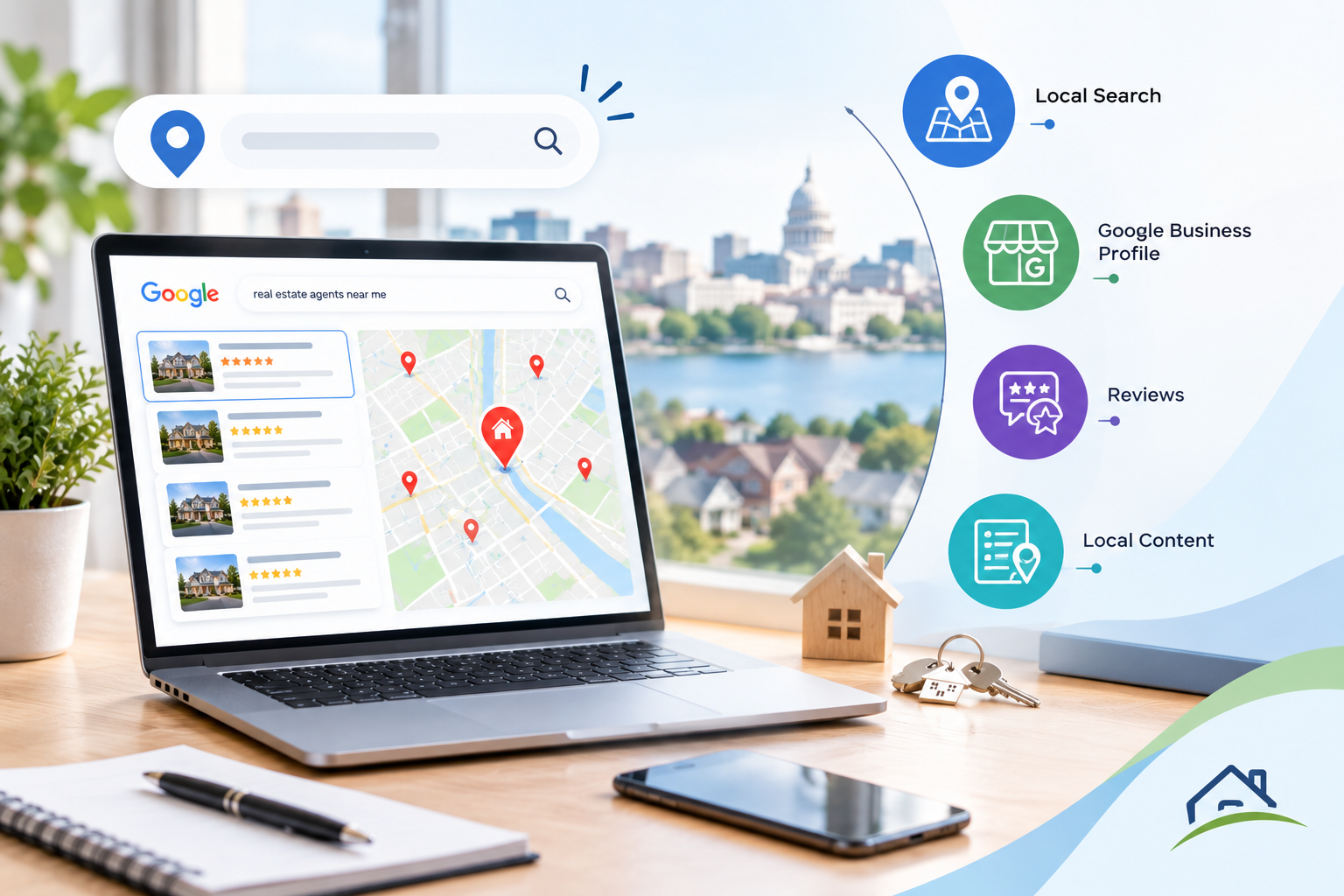
Local SEO for real estate agents is a digital marketing strategy that improves an agent’s visibility in Google Maps, the Local Map Pack, and location-based search results. It helps realtors attract nearby buyers and sellers by optimizing business profiles, reviews, local website content, and online business information.
Why Local SEO Matters for Real Estate Agents
When buyers and sellers search for a real estate agent, they often look for professionals who understand their city, neighborhoods, and local housing market. Searches such as “real estate agent near me,” “best realtor in Madison,” or “listing agent in Middleton” show that people want relevant local services.
Local SEO helps agents appear when potential clients search for these services. Unlike paid advertising, which generally requires ongoing spending to maintain campaign visibility, organic local optimization can build long-term discoverability when supported by consistent improvements.
A strong local search presence can help real estate professionals generate inquiries, receive calls, attract website visitors, and establish trust before the first conversation. It also gives agents opportunities to compete in specific neighborhoods without depending entirely on advertising.
For agents and team leaders, the goal is not simply to rank higher. It is to become easier for qualified local prospects to discover, evaluate, and contact.
The Three Pillars of Local Visibility
Google identifies three primary factors that influence local search rankings: relevance, distance, and prominence. Understanding these factors helps Real Estate Marketing Agency for Agents build a more effective local SEO strategy.
1. Relevance: Match Your Profile to Search Intent
Relevance measures how closely a real estate agent’s business profile matches a user’s search. To improve relevance, agents should choose the most accurate primary business category, clearly describe their services and expertise on their website and Google Business Profile, publish useful content about the cities and neighborhoods they serve, and maintain consistent business information across trusted online directories. For example, an agent serving Madison, Wisconsin, can create content about buying a home, preparing a property for sale, and understanding local market conditions. Clear service descriptions, accurate business details, and helpful local content also help AI-powered search tools understand an agent’s expertise, although they cannot guarantee AI citations or recommendations.
2. Distance: Understand How Location Affects Rankings
Distance refers to how far a business is from the searcher’s location or the location specified in a search query, which means a real estate agent may rank differently across neighborhoods and cities. Agents can improve local visibility by maintaining an accurate business address when eligible, setting the correct service area, creating useful city and neighborhood pages, sharing local market insights, and earning relevant links and mentions from reputable organizations. Since keyword optimization alone cannot overcome distance, agents should focus on the areas they genuinely serve and follow Google Business Profile guidelines, avoiding fake office locations or virtual offices used to manipulate rankings.
3. Prominence: Build Trust and Local Authority
Prominence reflects how well-known and trusted a real estate business appears to be, with Google considering factors such as reviews, links, and reputation signals. Agents can strengthen prominence by requesting honest client reviews, responding professionally to feedback, earning links from relevant local organizations and community publications, publishing accurate market updates and neighborhood guides, and maintaining consistent business information online. AI-powered search systems may also use public business profiles, reviews, websites, and other sources to understand an agent’s expertise. A consistent and credible online presence can improve trust and visibility, although ranking and AI citations are not guaranteed.
Google Business Profile Optimization Steps for Realtors
Google Business Profile is a central part of local SEO because eligible businesses can appear in Google Search and Maps. A complete, accurate profile helps prospective clients understand the services offered and how to make contact.
Step 1: Claim and Verify Your Profile
Claim or create a Google Business Profile for your eligible real estate business and complete Google's verification process. Ensure your business name, address, phone number, website, and other details are accurate and consistent. Use your official business name without adding unnecessary keywords or locations. Agents working under a brokerage should confirm their eligibility for an individual profile, avoid duplicate listings, and use the brokerage's address only when it meets Google's requirements.
Step 2: Select the Correct Primary and Secondary Categories
Business categories help Google understand a business’s services and influence its relevance to local searches. Choose the most accurate primary category, such as Real Estate Agency for an eligible agency or Real Estate Agent for an individual agent, when available and applicable. Avoid selecting Real Estate Appraiser unless appraisal services are genuinely offered. Add secondary categories only when they reflect the business’s actual services, as more categories do not automatically improve rankings. Review the available options in Google Business Profile regularly, since category names and availability may change.
Step 3: Complete Your Business Information
Keep your Google Business Profile accurate and up to date by providing your business name, eligible address or service area, primary phone number, website URL, business hours, relevant description, and available services or appointment details. Ensure your website reflects the same business identity and clearly communicates your location, real estate services, and local expertise, such as serving Madison, Wisconsin, to build trust and strengthen local search visibility.
Step 4: Add Relevant Photos and Updates
Use authentic photos of the agent, office, team, and property-related activities to help clients recognize the business and understand its services. Keep Google Business Profile information, including services and business hours, up to date, and share relevant announcements, local market updates, and business news through profile posts instead of repetitive promotional content.
Step 5: Build a Consistent Review Process
Reviews help potential clients evaluate a real estate professional and can strengthen local business prominence. Agents should consistently request honest feedback after genuine client experiences using Google-approved methods, such as sharing a review link. Review velocity refers to how frequently new reviews are received, but no specific frequency guarantees higher rankings. Focus on earning reviews naturally over time, never buy reviews or offer incentives for positive feedback, and respond professionally while protecting confidential client and transaction information.
Step 6: Monitor Profile Performance
Monitor your Google Business Profile performance by tracking available metrics such as searches, profile views, calls, website clicks, and other customer interactions. Use these insights to identify areas for improvement. For example, if people view your profile but rarely visit your website or call, make sure your services, contact information, and next steps are clear and easy to find.
Checklist: What Fails in Local SEO vs. What Wins in Local SEO
|
What Fails in Local SEO |
What Wins in Local SEO |
|
Using an inaccurate business category |
Selecting the most accurate primary category |
|
Adding keywords to a business name unnecessarily |
Using the real-world business name |
|
Creating fake office locations |
Maintaining an eligible, accurate profile |
|
Repeating city names unnaturally |
Publishing useful, location-specific content |
|
Buying reviews or offering rewards for positive feedback |
Requesting honest reviews through permitted methods |
|
Creating duplicate or near-identical location pages |
Building distinctive pages for areas genuinely served |
|
Ignoring negative reviews |
Responding professionally and protecting client privacy |
|
Leaving outdated contact information online |
Maintaining consistent, current business details |
|
Publishing generic content without local expertise |
Sharing accurate neighborhood and market information |
|
Tracking rankings alone |
Monitoring calls, website visits, inquiries, and leads |
Measure and Improve Your Local SEO Results
Local SEO should be measured through meaningful business outcomes, not just ranking positions. A real estate agent may appear in different positions depending on the searcher's location, device, and query.
Use Google Business Profile performance data, Google Search Console, and Google Analytics to track local search impressions, organic clicks, profile calls and website interactions, visits to location-specific pages, contact form submissions, consultation requests, qualified buyer and seller inquiries, and leads generated through organic search. Review these metrics monthly or quarterly to identify which pages, services, and local topics attract the most relevant prospects, then improve underperforming pages, update outdated content, and make it easier for visitors to contact you. Local SEO takes time, and results depend on competition, location, business eligibility, and implementation quality, so consistent improvements are more sustainable than attempts to manipulate rankings.
Frequently Asked Questions
1. How can real estate agents rank in Google's Local Map Pack?
Agents can improve their chances by maintaining an eligible and complete Google Business Profile, selecting accurate categories, earning genuine reviews, building relevant local website content, and strengthening their online prominence. Rankings also depend on distance and competition.
2. How long does local SEO take for real estate agents?
Results vary based on the market, competition, website condition, and existing reputation. Some improvements may produce early engagement, while meaningful ranking and lead-generation progress can take several months. No specific timeline is guaranteed.
3. Do Google reviews improve local SEO for realtors?
Reviews can contribute to local prominence and influence how prospective clients evaluate an agent. Genuine, relevant feedback and professional responses support trust, but review count alone does not guarantee higher rankings.
Conclusion
Local SEO helps real estate agents improve visibility among nearby buyers and sellers without depending entirely on paid advertising. By optimizing their Google Business Profile, earning genuine client reviews, publishing location-specific website content, maintaining consistent business information, and tracking performance, agents can strengthen their local presence. Focusing on relevance, distance, and prominence helps attract qualified inquiries while giving search engines and AI-powered tools clear information about the agent’s services, expertise, and target communities.