|
TL;DR — Key Takeaway Buyers increasingly search by neighborhood name, not generic terms like "homes for sale." A handful of genuinely useful neighborhood pages on your website can do more for your visibility than a large volume of generic blog posts. |
If you had to guess how a buyer searches for their next home today, "homes for sale" probably isn't it anymore. More often it's something specific: "best neighborhoods for families in [city]" or "[neighborhood name] homes." People already know roughly where they want to live — they're trying to confirm it, and trying to find someone who actually knows that area. That's the exact moment a well-built neighborhood page puts you in front of them.
Why Buyers Search by Neighborhood, Not Just City
Searches like "realtor near me" and neighborhood-specific queries have grown enormously over the past decade, and that shift reflects something real about how people shop for homes now. They've usually already narrowed things down using a map app or a friend's recommendation before they ever start Googling agents — so by the time they search, they're looking for local expertise, not a generic listing site.
This works in your favor as an individual agent. A big portal can show listings in a neighborhood, but it can't tell a buyer what it's actually like to live there. You can. That's the gap a neighborhood page fills.
What a Good Neighborhood Page Actually Includes
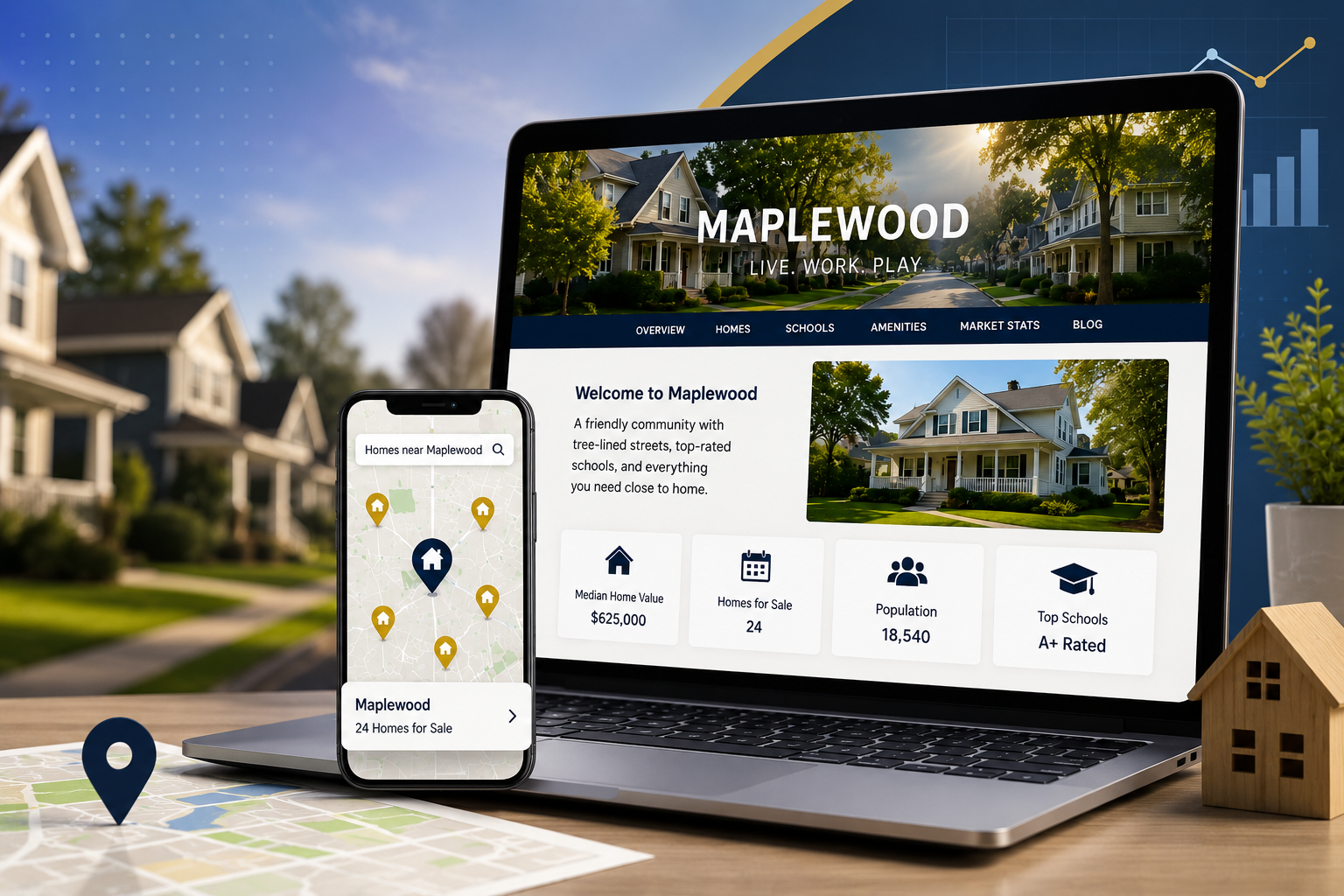
A neighborhood page that helps you get found isn't a listing feed with a paragraph of filler text above it. It's a genuinely useful mini-guide that answers the questions a buyer would ask a friend who already lives there.
● A short, honest description of the vibe — who tends to live there, what it feels like day to day
● School information, since this is one of the first things families search for
● Commute basics — distance to downtown, major employers, or a highway/transit line, in plain terms
● A few specific landmarks, parks, or local spots — the kind of detail only someone who actually knows the area would include
● A simple price range snapshot, so buyers can self-qualify before reaching out
● A clear way to contact you specifically about that neighborhood, not just a generic "contact us" link
None of this needs to read like a brochure. The pages that perform best usually sound like an honest local telling a friend what they'd actually want to know — including the small tradeoffs, not just the highlights.
A Simple Structure You Could Copy Today
You don't need a content team to put one of these together. A workable structure looks like this:
● Headline: "Living in [Neighborhood] — What It's Really Like"
● 2-3 sentence intro capturing the overall feel of the area
● A short "Who lives here" section — families, young professionals, retirees, etc.
● Schools and commute, in a few plain sentences each
● 3-5 local favorites: a coffee shop, a park, a restaurant
● Current price range for homes in the area
● A short closing note inviting buyers to reach out to you specifically about that neighborhood
Start with the two or three neighborhoods you know best and actually work in most — depth on a few pages beats a thin page for every zip code in your market.
How This One Page Type Supports Everything Else You Do
A good neighborhood page doesn't just sit there quietly. It gives you something specific to link to from your Google Business Profile posts, something concrete to mention in a listing presentation, and something worth sharing when a friend asks "what's [neighborhood] actually like?" It also gives past clients an easy, natural reason to send a friend your way — "here, this agent wrote up exactly what you're asking about."
A good neighborhood page doesn't just sit there quietly. It gives you something specific to link to from your Google Business Profile posts, something concrete to mention in a listing presentation, and something worth sharing when a friend asks "what's [neighborhood] actually like?" As part of digital marketing for realtors, it also gives past clients an easy, natural reason to send a friend your way — "here, this agent wrote up exactly what you're asking about."
Over time, a small set of these pages becomes one of the more durable assets on your site: unlike a market update, a good neighborhood guide doesn't go stale in a month.
Checklist: Which Neighborhoods to Start With
● The 2-3 neighborhoods where you've closed the most transactions
● Any neighborhood you personally live in or know especially well
● Areas where you're seeing rising buyer interest but limited competition from other agents' content
● Neighborhoods that come up often in client conversations, even if you haven't closed much there yet
Frequently Asked Questions
How many neighborhood pages should I have? Start with 2-3 done well rather than a dozen done thinly. You can always add more once you have a rhythm for building them.
Do I need professional photos for these pages? Good photos help, but honest, specific writing matters more. A page with real detail and average photos will still outperform generic filler text with stock images.
Should I update these pages over time? Yes — refresh the price range every few months and update anything that's changed, like a new development or a closed local business.
Can I write about a neighborhood I haven't personally sold in yet? Yes, as long as you're honest and specific. Spend time there, talk to people who live there, and avoid generic filler that could describe any neighborhood.
Will this actually bring in leads, or is it just nice content? It works best as part of a broader presence — paired with your Google Business Profile and consistent reviews, it gives local buyers a reason to choose you specifically over a generic portal listing.
Conclusion
You don't need a content calendar or a marketing team to make this work. A few honest, detailed neighborhood pages — the kind that read like a knowledgeable friend, not a brochure — can quietly become one of the most useful pages on your entire website.
Want help building out neighborhood pages for your market? Book a free 15-minute review with Realtor Marketing Labs and we'll help you map out where to start.